Breaking: Gaza Ceasefire Shatters with Drone Strike Killing Two Brothers — Innocent Errand or Armed Threat?
noviembre 30, 2025
How SIM Cards in Russian Drones and eSIMs Became Part of the Drone War
diciembre 1, 2025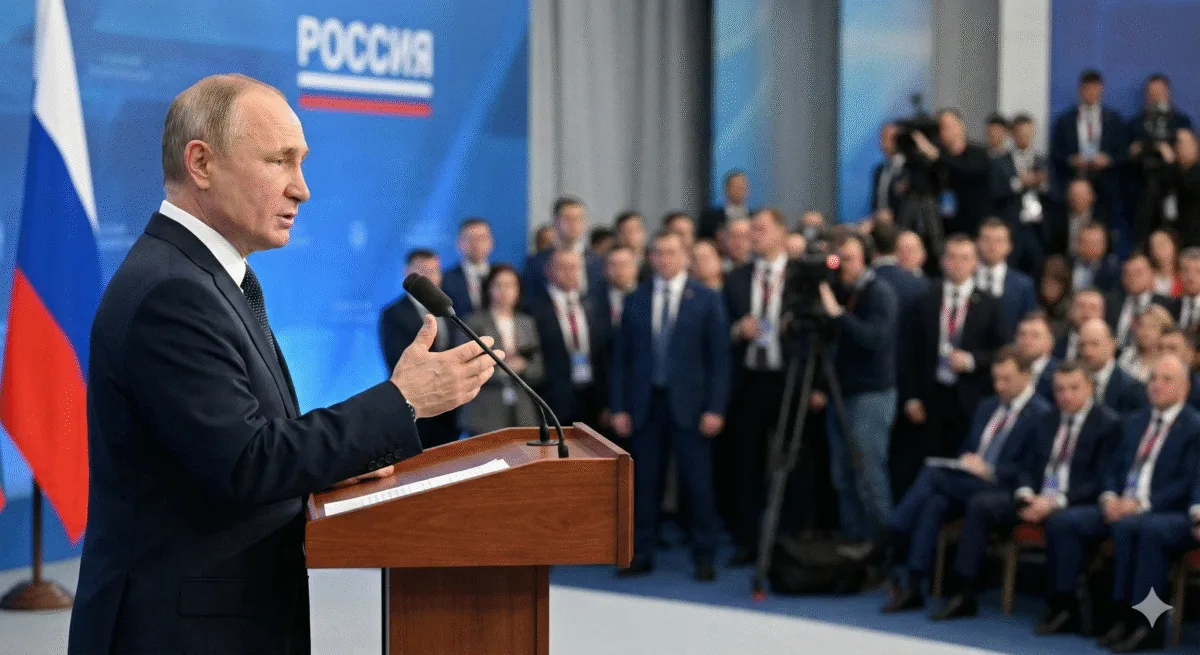
Putin Sets Hard Line for Ending Ukraine War as US Peace Push Intensifies
Russian President Vladimir Putin has restated his core conditions for ending the war in Ukraine, saying Moscow will only stop fighting if Ukrainian troops withdraw from all territories Russia claims as its own and if those land gains are formally recognised.
Speaking to reporters during a visit to Kyrgyzstan, Putin said Russia was “ready in principle to fight to the last Ukrainian” – a phrase that shocked many in Ukraine and in the West, even as new peace efforts gather pace.
What exactly did Putin say?
At a press conference in Bishkek, Putin repeated his long-standing demand:
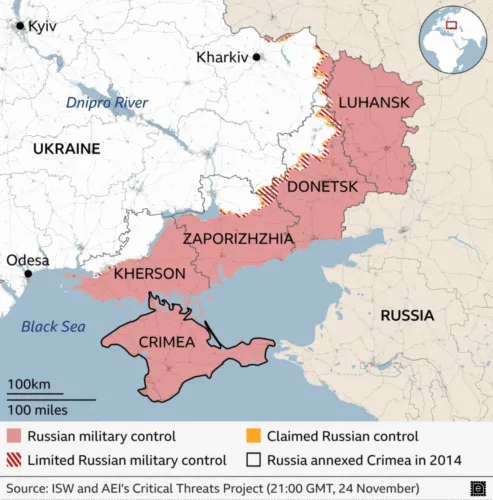
Ukrainian forces must leave the eastern Donbas region (the Luhansk and Donetsk provinces)
Kyiv must accept Russian control over four regions Russia claims to have annexed (Luhansk, Donetsk, Zaporizhzhia and Kherson)
plus Crimea, seized in 2014
“If they don’t withdraw, we’ll achieve this by force of arms,” he said, insisting that Russia has the initiative on the battlefield and that the conflict will only end on these terms.
He also claimed Ukraine’s current leadership is “illegitimate” because the country has not held elections under wartime martial law, and said it was “pointless” to sign documents with President Volodymyr Zelensky’s government.
Ukraine’s position: no reward for aggression
For Kyiv, Putin’s conditions are unacceptable. Zelensky and his team have repeatedly ruled out giving up the parts of Donbas still under Ukrainian control or recognising Russian claims over any occupied land.
In a video address, Zelensky said Russia had “scorned” efforts “to truly end the war” and warned that no Ukrainian leader “with half a brain” could sign a deal that hands over large parts of the country.
Ukraine argues that agreeing to such terms would:
reward aggression
set a dangerous precedent for other conflicts
and leave the country vulnerable to future attacks
Instead, Kyiv is pushing for:
full sovereignty over its internationally recognised borders
strong security guarantees from the US and Europe
long-term military and financial support
The US peace plan and Trump’s envoys
Putin’s comments come as a new US-driven peace initiative moves forward.
Washington initially produced a peace plan drafted largely by American and Russian officials, which critics said strongly favored Moscow’s interests – including on territory and limits to Ukraine’s armed forces.
After a backlash from Kyiv and European capitals, the plan was cut down and heavily revised during talks between US and Ukrainian negotiators in Geneva. European representatives were also present.
US President Donald Trump says there are now “only a few remaining points of disagreement” and has appointed real-estate developer Steve Witkoff as his special envoy. Witkoff is expected to travel to Moscow soon, possibly joined by Trump’s son-in-law Jared Kushner, to present the latest version of the plan directly to Putin.
On the Ukrainian side, a delegation will meet US officials again to “translate” what was agreed in Geneva into a more detailed document. Ukraine’s negotiating team is now led by national security official Rustem Umerov.
What’s the main sticking point?
The biggest unresolved issue is territory.
Even the revised peace proposals do not fully settle what should happen to the regions currently occupied by Russia. For Ukraine, agreeing to permanent Russian control is a red line; for Moscow, any deal that does not cement its territorial gains is not worth signing.
There are also disputes over:
Security guarantees – how strong they should be and who will enforce them
Limits on Ukraine’s military – early drafts tried to cap the size of the Ukrainian army, something European leaders now say they will not accept
Economic sanctions and frozen Russian assets – Europe wants to keep leverage over Moscow and use some assets to help rebuild Ukraine; Russia wants restrictions lifted
What happens next?
In the coming days:
A US delegation headed by envoy Steve Witkoff is expected in Moscow to hear Russia’s reaction to the latest draft
Ukrainian and US negotiators will continue talks to refine the text and try to agree on security guarantees and political language
European leaders will keep pushing to toughen the deal’s terms on sanctions, Ukraine’s sovereignty and long-term defence
For now, the core positions remain very far apart:
Putin wants Ukraine to give up large parts of its territory and accept them as Russian forever
Ukraine refuses to surrender land or accept a deal it sees as rewarding aggression
The US and Europe are trying to bridge that gap without abandoning Kyiv or handing a clear victory to Moscow
Whether the new peace push leads to a real ceasefire or just another round of pressure on Ukraine will depend on what happens in closed-door meetings in Geneva, Moscow and other capitals — and what continues to happen on the battlefields of the Donbas.