Peace on Putin’s Terms: Why Russia Demands Ukraine Withdraw from Claimed Lands
noviembre 30, 2025
Read This Before Visiting Turkey: Essential Tips & Culture Shocks
diciembre 3, 2025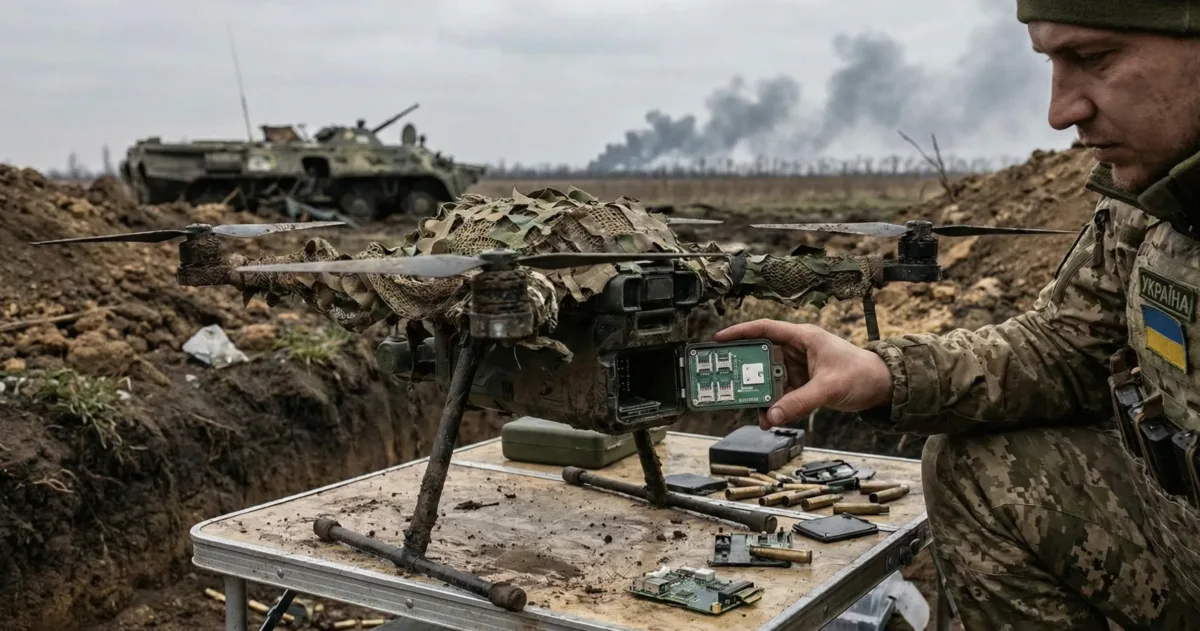
The New Frontline: How SIM Cards and eSIMs Are Powering the Drone War in Ukraine
When Ukrainian forces recovered the wreckage of a Russian Shahed drone, they found something ordinary but revealing inside — a small 4G modem with a SIM card. It looked like a regular piece of consumer tech, the same used in smartphones, yet it had helped guide a weapon hundreds of kilometres to its target.
Since early 2025, evidence has shown that both Russian and Ukrainian drones are increasingly connected through mobile networks — using traditional SIM cards or digital eSIMs — to extend range and mask their signals. What started as a niche experiment has become a central part of modern drone warfare.
Global concern over SIM and eSIM misuse
Investigators say the problem extends beyond Ukraine. Modern drones can use either physical SIM cards or eSIM profiles, which can be activated remotely and in bulk. These digital SIMs make it possible to connect large numbers of drones without physical distribution.
Because eSIMs are software-based, they can be purchased online, activated instantly, and used across borders. This flexibility has attracted attention from Interpol and other international police agencies, which have reportedly contacted several global eSIM providers — including travel-data companies to share information when suspicious activity is detected.
The goal is not to blame providers but to trace connections that might help identify where drone control links are coming from. Experts say even limited metadata, like which country a profile was active in, can provide crucial leads in investigations.

The aftermath of a drone strike, where the wreckage of a downed UAV reveals the reliance on civilian connectivity hardware, such as SIM cards in Russian drones
A shared innovation — and a shared risk
Ukraine’s own forces have reportedly used similar methods to guide long-range FPV (first-person-view) drones deep into occupied areas. Russian units, in turn, have adapted the same idea for attack drones launched from across the border.
Experts describe a “network battlefield,” where both sides depend on the same commercial communications towers and civilian data systems to operate. The discovery of SIM cards in Russian drones is only one part of a much broader pattern: both militaries are learning that the safest way to transmit commands might be through the same channels everyone uses to text or stream video.
The approach offers key advantages:
Extended range: As long as there is mobile coverage, a drone can stay connected.
Reduced detectability: Military signals blend with normal civilian data.
Lower cost: Off-the-shelf SIM cards and modems are far cheaper than dedicated military systems.
But it also introduces major security risks. Telecom providers now face challenges in preventing their networks from being used to support attacks, often without their knowledge.
Civilian networks turned into military tools
Analysts say the tactic is simple but powerful. By connecting drones to 4G or LTE networks, operators can control or monitor them far beyond normal radio range. This is possible because the mobile network, originally designed for phones and tablets, provides a stable, encrypted data link that covers most of the region.
This shift blurs the line between civilian and military infrastructure. A drone linked through a SIM card in a Russian drone or an eSIM in a Ukrainian one may appear to the network just like a regular smartphone connection. That makes it difficult for defenders to jam or track without also disrupting normal communications for millions of people.
Electronic-warfare specialists explain that traditional radio-controlled drones are easy to block because they use predictable military frequencies. But when control signals are hidden inside ordinary 4G or 5G traffic, interference becomes almost impossible without shutting down an entire city’s mobile service.
War through everyday technology
The presence of SIM cards in Russian drones and similar systems on the Ukrainian side marks a turning point in how wars are fought. The same technology that powers social media, navigation, and online messaging is now part of military strategy.
Mobile networks — built for connection and convenience — have become invisible battlegrounds. As both sides race to outsmart each other, the line between civilian technology and military weaponry continues to fade.
For the people living under these skies, that means the phone signal that helps them call for help or check the news is also the signal guiding the drones above them.