eSIM QR Code: How to Scan, Install, and Fix Common Problems
November 19, 2025
Breaking: Gaza Ceasefire Shatters with Drone Strike Killing Two Brothers — Innocent Errand or Armed Threat?
November 30, 2025
Turkey is one of those countries where good internet makes your trip so much easier.
You need it for maps, hotel check-ins, QR menus, WhatsApp, and last-minute tickets.
But in 2025, there is a twist:
Turkey blocks many international eSIM apps and websites inside the country.
Local tourist SIM cards are often expensive, especially at airports.
So which is better for you: eSIM vs physical SIM in Turkey?
This guide keeps things simple, friendly, and real.
Quick Version: What Should You Choose?
If you do not want to read everything, here is the short answer.
Trip up to 2 weeks:
Use an eSIM, and install + activate it before you land in Turkey.Trip 3+ weeks or you need a Turkish number:
Get a physical SIM card from an official Turkcell / Vodafone / Türk Telekom shop in the city.Only a few days and your home carrier has a cheap roaming pack:
Check roaming prices. Sometimes a simple roaming add-on is enough.Important 2025 rule:
Turkey has blocked many eSIM apps (Airalo, Holafly, Saily, Nomad and more) inside the country. You must buy and activate your eSIM before arriving.
Now let’s zoom out and compare eSIM vs physical SIM in Turkey step by step.
How Mobile Internet Works in Turkey in 2025
The Big Three Networks
Turkey has three main mobile operators:
Turkcell – best overall coverage, strong even outside cities
Türk Telekom – usually the cheapest, good in cities
Vodafone Turkey – middle option, okay coverage and price
For popular places like Istanbul, Cappadocia, Antalya, Izmir, all three work fine. Turkcell is usually strongest if you go off the main tourist path.
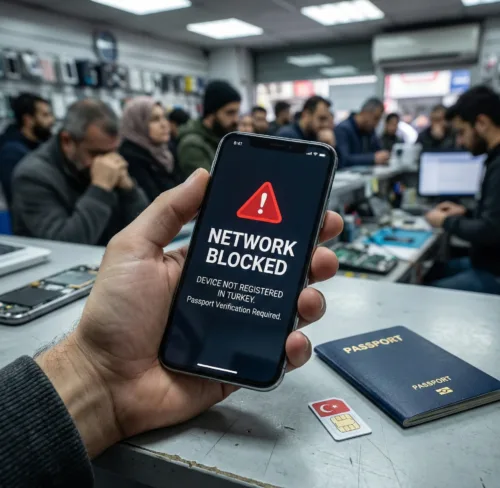
Warning: Network Blocked? This alarming screen relates to Turkey's strict IMEI registration rule for foreign phones. Read below to understand why this usually won't affect short-term holidaymakers.
Passport & SIM Registration
Turkey has strict ID rules for mobile phones. To buy a physical Turkish SIM, you must show your passport, and the SIM is then registered in your name under Turkish law.
There is also an IMEI rule:
If you use a Turkish SIM in a foreign phone for more than about 120 days, the phone can be blocked from Turkish networks unless you pay a high registration fee.
For normal holidays (less than 90–120 days), you do not need to worry about this.
The 2025 eSIM Ban: What Actually Changed?
Since mid-2024 and into 2025, Turkey’s regulator has blocked access to many international eSIM provider websites and apps inside Turkey (Holafly, Airalo, Saily, Nomad and others).
Important:
The eSIM itself still works on the network.
The problem is: inside Turkey you often cannot open the eSIM app or website to buy, install, or manage it.
So travelers and digital nomads now say:
“Activate your eSIM the day before your flight and you’re fine.”
Some also use a VPN to reach blocked sites if they need to top up later.
This is the key detail in the eSIM vs physical SIM Turkey decision.
Option 1 – Using an eSIM in Turkey
What Is an eSIM in Simple Words?
An eSIM is a digital SIM already built into your phone.
No plastic card
No shop or kiosk
You just scan a QR code and download a data plan.
Most recent iPhones and many Android phones support eSIM. Older or very cheap models may not. Always check first.
How to Set Up an eSIM for Turkey (Step by Step)
Check your phone
Look in your phone settings or on the provider website to see if your phone supports eSIM.Choose a travel eSIM provider
There are many options (Nomad, Airalo, Saily, Holafly, Yesim, Maya and others). Most of them use Turkcell or Türk Telekom networks in the background.Buy and install your eSIM BEFORE you fly
Buy your plan online.
Scan the QR code and add the eSIM to your phone at home.
Activate data before or just after take-off
Many travelers turn on the eSIM when they leave their home country or when the plane lands.
Save everything offline
Screenshot the QR code.
Save your eSIM confirmation email.
Download offline maps and hotel bookings.
Pros of eSIM in Turkey
Real benefits of choosing eSIM vs physical SIM in Turkey:
No queues at airport or city shops
No need to show a passport
Easy to keep your home SIM in the phone for SMS and calls
Good if you change cities a lot or arrive late at night
Often cheaper than airport tourist SIMs, especially for light or medium data use
Digital nomads in forums often say they prefer a third-party eSIM in Turkey because local tourist SIM prices are “wild” and sometimes confusing.
Cons of eSIM in Turkey
There are also clear downsides:
You rarely get a Turkish phone number (most travel eSIMs are data-only).
Many eSIM apps and websites are blocked in Turkey, so you cannot buy or manage new plans while you are there without a VPN.
If something goes wrong and you did not prepare screenshots or instructions, support can be slower to access.
In short: great if you prepare, stressful if you do not.
Option 2 – Buying a Physical SIM Card in Turkey
Where Can You Buy a SIM Card?
You usually have three choices:
Airport kiosks
Very easy after you land
Staff usually speak English
But prices are often 20–50% more than in the city, and tourist plans can be quite expensive
Official stores in the city (Turkcell, Vodafone, Türk Telekom)
Better prices and more choice
Normal working hours only
You may need to wait in line and deal with some language issues
Random phone shops / kiosks
Everywhere, very convenient
But sometimes they push expensive tourist packages, and the pricing is not always clear
What You Need to Bring
To get a physical SIM, you will need:
Your passport
Some cash or card in Turkish lira
A bit of time (activation can take from a few minutes up to about an hour)
The staff will usually:
Register the SIM in your name
Insert it for you
Check that mobile data works before you leave
Pros of a Physical SIM in Turkey
Choosing a physical SIM vs eSIM in Turkey is better when:
You need a Turkish phone number for local calls, SMS, deliveries, or banks
You stay several weeks or a month and want a large bundle (20–40 GB or more)
You do not want to deal with banned apps, VPNs or QR codes at all
Turkcell, Vodafone, and Türk Telekom all sell tourist SIMs with a mix of data, minutes and SMS.
Cons of a Physical SIM
Tourist SIMs are often expensive, especially at airports.
You must carry and protect your home SIM somewhere.
For stays longer than about 120 days, your foreign phone can be blocked from Turkish networks unless you pay a high IMEI registration fee.
For most holiday trips, these long-stay IMEI rules are not a problem, but they matter for students and long-term nomads.
Price Comparison: eSIM vs Physical SIM vs Roaming vs Pocket Wi-Fi
Prices change often in Turkey, but here is a simple 2025 snapshot.
Example Prices (Approximate)
| Option | Typical 7–10 Day Cost | Data Example | Setup Time | Best For |
|---|---|---|---|---|
| Travel eSIM | US$4–23 | 1–20 GB | 5–15 minutes | Short trips, light–medium users |
| Tourist physical SIM | ₺1,200–₺1,800 (≈ US$35–55) | 20–35 GB + calls + SMS | 30–60 minutes | Longer stays, need local number |
| Pocket Wi-Fi | US$30–50 per week | Usually “unlimited” (fair use) | Pick-up / delivery | Groups, families sharing data |
| Roaming from home SIM | US$35–70 per week | Depends on your carrier | 0–5 minutes | Very short trips, lazy setup |
Checklists: What to Do Before and After You Fly
Day Before Your Flight
Check if your phone supports eSIM.
Choose and buy your Turkey eSIM if you plan to use one.
Scan the QR code and install it on your phone.
Download offline maps, your boarding pass, and your hotel details.
Install a VPN app if you think you may need it.
At the Airport in Turkey (If Buying a SIM)
Follow signs to official Turkcell / Vodafone / Türk Telekom shops.
Compare prices between airport kiosks if there are several.
Have your passport ready.
Confirm what is included: data, minutes, SMS, validity days, total price.
Ask the staff to test mobile data before you leave the store.
Final Thoughts: The Best Connection Is the One You Don’t Think About
In the end, there is no one perfect winner in the eSIM vs physical SIM Turkey battle.
eSIMs are fast, light and cheap when you prepare in advance.
Physical SIMs are solid and simple when you need a local number and plan to stay longer.
Roaming and pocket Wi-Fi fill special cases for very short trips or big groups.
The best choice is the one that fits your trip length, budget, and stress level.
Set things up before you go. Screenshot what matters. Then put your phone back in your pocket.
The best journeys in Turkey start when you stop worrying about signal and start watching the Bosphorus, the balloons in Cappadocia, or the sun on the Aegean instead.
FAQ: eSIM vs Physical SIM Turkey
1. Will my eSIM still work after the ban?
Yes, in most cases the eSIM itself works normally if it was purchased, installed, and activated before you arrive. The ban is mainly on accessing some eSIM apps and websites from inside Turkey.
2. Can I buy or activate an eSIM after I land in Turkey?
Sometimes you can, but it is not safe to rely on it. Many provider sites and apps are blocked, so you may not even reach the purchase page. Most travel blogs and eSIM companies now say: set everything up before your flight.
3. Do I really need my passport for a Turkish SIM card?
Yes. For a physical SIM, shops must register it to a person, so they ask for your passport. eSIMs do not usually require ID.
4. Will my phone get blocked if I only stay two weeks?
No. IMEI blocking is for long stays (over about 90–120 days) when using a Turkish SIM in a foreign phone. Short tourist trips are fine.
5. Can I keep my WhatsApp number if I change to a Turkish SIM or eSIM?
Yes. WhatsApp is linked to your account, not your active SIM card. You can keep your old number in WhatsApp even if you use a Turkey eSIM or SIM for data.